Your domain name appears on your website, your email addresses, your business cards, and your advertising, so it is worth choosing carefully. A good one is easy to say, easy to spell, and easy to remember.
What makes a good domain name
- Short and simple. The fewer characters, the fewer chances for mistakes.
- Easy to say aloud. If you have to spell it out every time, it is working against you.
- Close to your business name. People should be able to guess it.
- Free of awkward hyphens and numbers. They get forgotten or typed wrong.
- Not confusingly close to a competitor. Avoid names that could send customers to someone else.
.ca or .com?
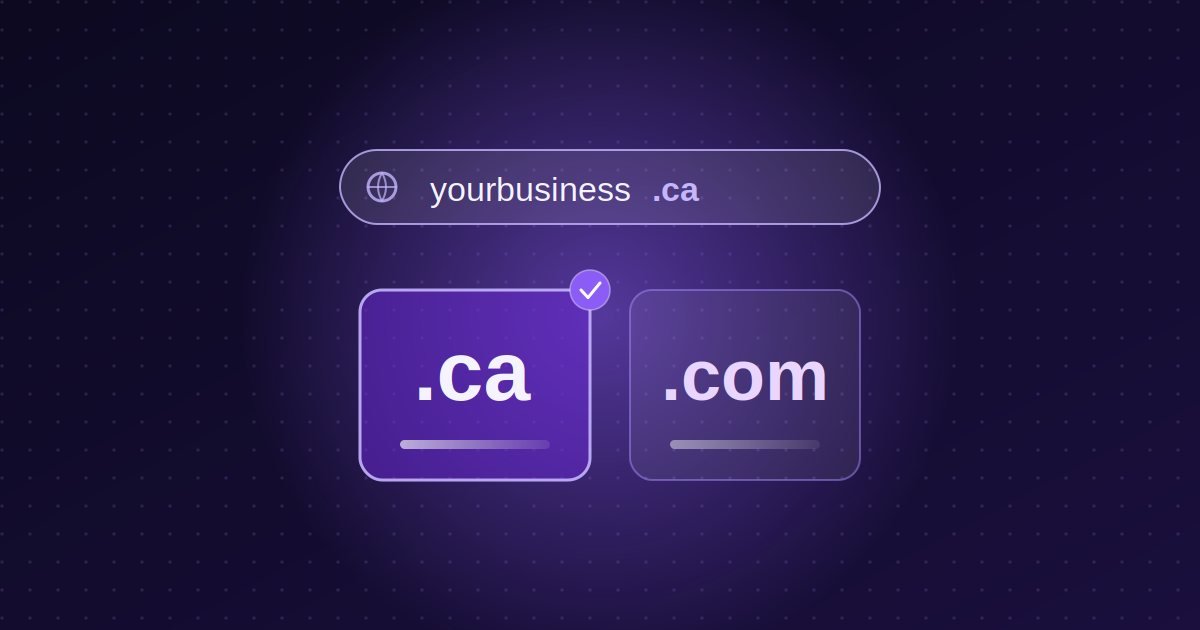
A .ca domain signals that your business is Canadian and can reassure local customers. The .ca domain is managed by the Canadian Internet Registration Authority, and registering one generally requires meeting its Canadian presence requirements, so check the current rules when you register. A .com is the most widely recognized extension, which can help if you serve or plan to serve customers outside Canada.
For a local business serving Nova Scotia customers, a .ca is often a natural choice. Many businesses register both and point one to the other, which also prevents someone else from taking the version you did not choose. A .ca also tells search engines that your site is aimed at Canada, while a .com is treated as global, so the decision comes down to your audience and your plans.
Think about your email too
An email address at your own domain, such as name@yourbusiness.ca, looks more professional and trustworthy than a free email address. Plan for this when you pick your domain.
Avoid the common account mistakes
- Register the domain in your own name or your business name. Do not let a web designer register it only in theirs, or you may struggle to prove ownership later.
- Use an email address you will always have access to as the account contact, since renewal notices and transfer codes go there.
- Turn on auto renewal, or put a reminder in your calendar. Losing a domain because it expired can mean losing your website and email.
- Keep the login details safe, with two-factor authentication turned on. See our website security basics.
Changing a domain later
If you ever move to a new domain, set up redirects from every old page to its new equivalent so you keep your visitors and search visibility. It is easier to choose well the first time, which is part of what we help with in our web design work. If you are weighing options, book a free consultation.